In today’s fast-paced world of healthcare, patient safety and effective communication have never been more critical. Hospitals, nursing homes, and assisted living facilities are relying more and more on nurse call systems to bridge the caregiver-patient divide. Not only do these systems allow for quick response in emergency situations, but they also automate communication processes, reduce errors, and improve patient satisfaction across the board.
Over a period of time, nurse call systems have evolved from simple button-activated alarms to sophisticated, centralized communication systems. Today, they offer real-time location tracking, wireless communication, voice command requests, and even integration with electronic health records (EHRs). With the aging population and the growing demand for efficient healthcare services, the adoption of such systems will most likely expand exponentially within the next couple of years.
Among the most influential drivers of the trend is increasing emphasis on patient-centered care. Hospitals and care facilities are being forced to provide quality services while maintaining cost-effectiveness in operations. Nurse call systems allow caregivers to obtain real-time information, through which they can sequence interventions based on the requirements of the patients. For example, modern systems are able to distinguish between regular requests (eg water or mobility aid) and life -threatening emergencies (eg respiratory crisis), so that nurses can respond accordingly.
Apart from these, new technologies such as IoT, Cloud and AI change future nursing call systems. The IoT device offers end-to-end connection in the hospital’s network, and AI-controlled analysis provides future patient treatment insights. Not only does it optimize the convergence response time, but it also helps administrators to make effective decisions on resource distribution, reduce costs and improve the patient’s results up to the maximum.
Nurse Call Systems Market Outlook 2035
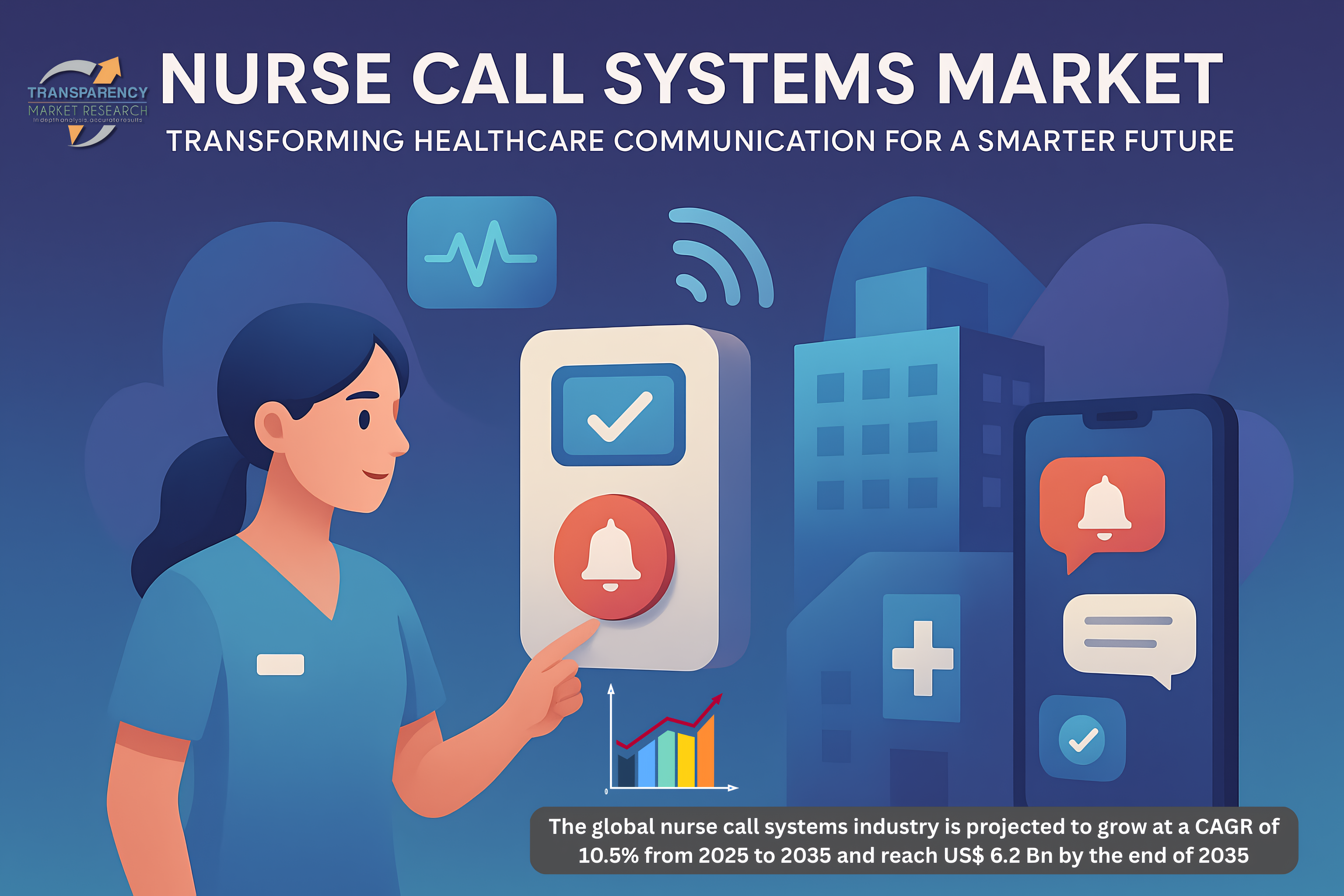
The global nurse call systems market was valued at US$ 2.1 Billion in 2024 and it is forecasted to grow at a 10.5% CAGR during the period 2025-2035 and reach US$ 6.2 Billion by 2035.
Key Market Drivers
1. Growing Aging Population
The growing community of elderly citizens across the globe has demanded better health centers to be developed. Elderly patients typically require immediate treatment, and thus nurse call systems become an essential requirement at hospitals and long-term care facilities.
2. Patient Safety Focus Intensifies
Health care providers and regulatory agencies are more concerned than ever with patient safety policies. Nurse call systems play a central role in the delivery of quick response times, medical error minimization, and overall patient satisfaction.
3. Technological Innovations
From wireless communication to artificial intelligence-driven systems, ongoing technological advancement is rendering nurse call systems smarter, more reliable, and easier to operate.
4. Healthcare Infrastructure Investments
Emerging economies are spending a great deal on sophisticated healthcare infrastructure, and this is likely to fuel the need for nurse call systems over the next decade.
Analysis of Key Players in the Nurse Call Systems Market
Worldwide nurse call systems market major players are focusing on innovation, line extension, and strategic alliances to strengthen their position. Their approach is to increase the effectiveness of the system, deliver differentiated offerings, and include innovative technologies to fulfill evolving healthcare providers’ needs.
A few of the top organizations driving expansion in this sector are:
- Intercall Systems
- FOREBIX SEMICON Technologies Pvt Ltd
- Johnson Controls
- Baxter International, Inc.
- Securitas Healthcare LLC.
- ASCOM Holdings AG
- TekTone Sound and Signal Mfg., Inc.
- Austco Healthcare
- Critical Alert Systems LLC
- West-Com Nurse Call Systems, Inc.
- JNL Technologies
- Cornell Communications
These firms are spending heavily on research and development (R&D) in the areas of AI, IoT, and wireless platforms in order to stay ahead. Strategic acquisitions and mergers and collaborations are also common practices to enhance market share and reach more geographies.
Future Prospects in the Nurse Call Systems Market
The next decade holds huge promise for the nurse call systems market. Areas to watch include:
- Telemedicine Platform Integration – With growing telehealth, remote monitoring systems could be integrated directly with nurse call systems.
- AI-Driven Predictive Alerts – Leverage AI to predict patient needs prior to them being emergencies.
- Wearable Devices Connectivity – Complete integration with smartwatches, fitness bands, and other wearable devices to provide real-time patient health data.
- Cloud-Based Systems – Cloud-based nurse call systems will be utilized to facilitate remote monitoring, reduce IT costs, and allow system scalability.
Challenges to Overcome
Despite the promising growth, the nurse call systems market also faces some challenges:
- High Costs of Implementation – Intricate systems with inherent features are expensive for small health facilities.
- Data Security – With nurse call systems being part of hospital networks and patient information, security is at the top of the list.
- Training the staff – It is difficult to have the healthcare professionals trained to use complex systems in the appropriate manner.
Conclusion
The nurse call system market is at the forefront of changing communication in healthcare and patient care. With widespread technology revolutions, growing healthcare needs, and a keen quest for patient safety, the industry will expand exponentially by 2035.
For health practitioners, the investment is not only in improving processes but also in building confidence and satisfaction among patients and their loved ones. For players in the industry, the future is about embracing innovation, cooperation, and digital convergence to enable next-generation communication solutions.
Fundamentally, nurse call systems are no longer just alarm systems—they are evolving into smart healthcare communications centers that are defining tomorrow’s patient care.