The global healthcare landscape is undergoing a quiet but powerful shift—one where patients are no longer passive recipients of care but active participants in managing their own conditions. At the heart of this transformation lies the autoinjectors market, a segment gaining remarkable traction as chronic diseases, biologics, and home-based care reshape modern medicine.
Autoinjectors, designed to deliver precise doses of injectable drugs with minimal effort, are becoming a preferred drug-delivery solution across therapeutic areas. From autoimmune disorders and diabetes to emergency care and oncology, these devices are redefining convenience, safety, and adherence.
Market Outlook: A Billion-Dollar Opportunity Through 2036
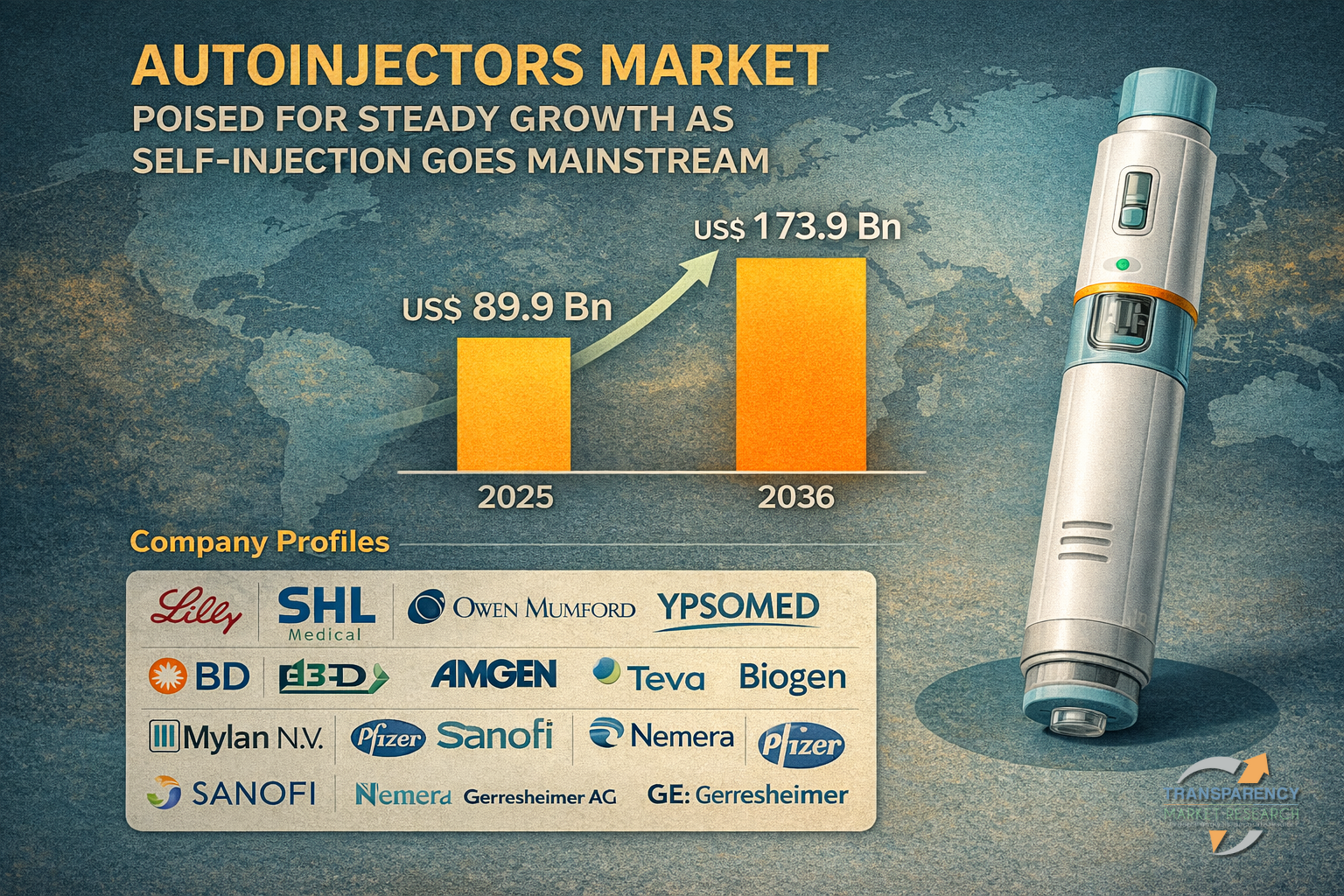
In 2025, the global autoinjectors market was valued at US$ 89.9 Bn, reflecting strong demand across both developed and emerging healthcare systems. Looking ahead, the market is projected to reach US$ 173.9 Bn by 2036, expanding at a compound annual growth rate (CAGR) of 6.2% from 2026 to 2036.
This sustained growth is being fueled by several converging factors:
- Rising prevalence of chronic and autoimmune diseases
- Increasing use of biologics and injectable therapies
- Growing preference for self-administered and home-based treatment options
- Technological advances improving device safety, ergonomics, and reliability
As healthcare systems aim to reduce hospital visits and empower patients, autoinjectors are emerging as a practical, scalable solution.
Why Demand for Autoinjectors Is Accelerating
One of the strongest drivers of the autoinjectors market is the growing burden of chronic diseases such as rheumatoid arthritis, multiple sclerosis, diabetes, and severe allergies. These conditions often require long-term injectable therapies, making ease of use and patient compliance critical.
Autoinjectors eliminate many barriers associated with conventional injections. They minimize needle anxiety, reduce dosing errors, and enable patients to administer medications safely without clinical supervision. This is especially valuable for elderly patients and those managing complex treatment regimens.
Additionally, the rapid adoption of biologic drugs, which are commonly delivered via injection, has significantly expanded the addressable market for autoinjector manufacturers.
Market Size Highlights at a Glance
- The autoinjectors market reached US$ 89.9 Billion in 2025
- Expected to grow to US$ 173.9 Billion by 2036
- Forecast CAGR of 6.2% between 2026 and 2036
- Disposable autoinjectors dominated the market with a 58.6% share in 2025
- North America led globally, accounting for 46.5% of total revenue in 2025
These figures underscore the market’s resilience and long-term growth potential.
Disposable Autoinjectors Lead by Product Type
By product, disposable autoinjectors held the largest market share in 2025. Their dominance is attributed to ease of use, reduced contamination risk, and minimal maintenance requirements. Pharmaceutical companies increasingly prefer disposable formats due to their compatibility with pre-filled syringes and improved patient safety profiles.
Reusable autoinjectors continue to gain attention, particularly in cost-sensitive and sustainability-focused markets, but disposable devices remain the industry standard for now.
North America Maintains Market Leadership
North America emerged as the largest regional market in 2025, capturing 46.5% of global revenue. High healthcare spending, widespread adoption of biologics, strong presence of leading pharmaceutical companies, and early uptake of advanced drug-delivery technologies have all contributed to regional dominance.
Europe follows closely, supported by favorable reimbursement policies and rising demand for patient-centric care. Meanwhile, Asia Pacific is expected to witness faster growth over the forecast period due to improving healthcare infrastructure and increasing awareness of self-injection therapies.
Competitive Landscape: Innovation at the Core
The autoinjectors market is moderately consolidated, with global players focusing heavily on device innovation, partnerships, and platform-based solutions.
Key companies operating in the market include:
Eli Lilly and Company, SHL Medical, Owen Mumford, Ypsomed, BD, E3D, Amgen Inc., Teva Pharmaceuticals USA, Inc., Biogen, Mylan N.V., Pfizer Inc., Union Medico ApS., Sanofi, Nemera, and Gerresheimer AG.
These players are investing in next-generation devices that improve usability, support high-viscosity drugs, and align with sustainability goals.
Recent Developments Shaping the Market
Innovation continues to define the competitive dynamics of the autoinjectors industry. Several notable developments in 2025 highlight the pace of progress:
- December 2025: SHL Medical unveiled a new autoinjector device at Pharmapack Europe 2026, designed to support automated reconstitution and delivery of lyophilized formulations—addressing a key challenge in biologic drug administration.
- October 2025: PharmaJet announced the development of needle-free self-injection pens for home use. These subcutaneous injector prototypes, currently in the testing phase, target chronic disease and metabolic peptide markets.
- October 2025: Ypsomed launched YpsoLoop, the first autoinjector platform built around circularity. The 1 ml and 2 ml versions enable automated disassembly and efficient recycling while maintaining the convenience of pre-filled, two-step operation.
- May 2025: CROSSJECT reported strong performance of its ZENEO needle-free autoinjector, demonstrating consistent intramuscular injection depth and highlighting its potential for emergency medical applications.
Looking Ahead
As healthcare continues to move beyond hospital walls, the autoinjectors market is set to play a pivotal role in enabling safe, effective, and patient-friendly drug delivery. With steady technological innovation and rising acceptance of self-injection, the market’s growth trajectory through 2036 remains strong.
For pharmaceutical companies, device manufacturers, and investors alike, autoinjectors represent not just a delivery mechanism—but a cornerstone of next-generation patient care.