IVD is at the heart of the paradigm shift that healthcare is going through. IVDs are diagnostic tests conducted outside the human body that play a crucial role in the detection, monitoring, and treatment pathways regarding diseases. With medical science advancing towards precision medicine, the need for accurate, efficient, and rapid diagnostics is increasing exponentially.
Overview of the Market & Future Outlook
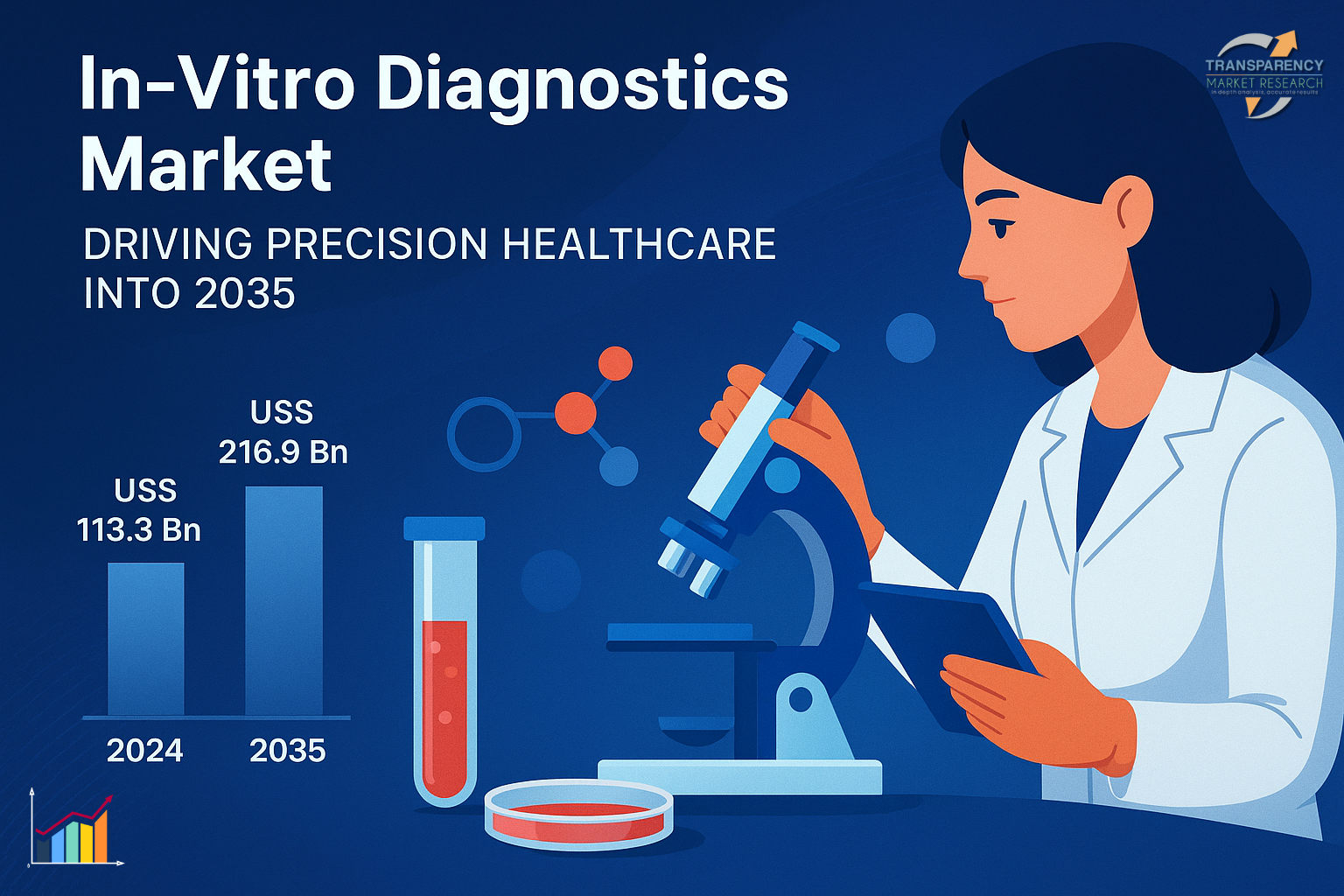
The global in-vitro diagnostics industry has established itself as the cornerstone of healthcare. With an estimated value of US$ 113.3 billion in 2024, the market is expected to exhibit robust growth, reaching beyond US$ 216.9 billion by 2035, while growing at a CAGR of 6.1% over the next ten years.
Early detection is increasingly becoming of prime importance as the population of the world ages and awareness of healthcare rises. In-vitro diagnostics prove invaluable for this purpose by providing valid results that are useful in making timely clinical decisions, hence enhancing patient outcomes and bringing down healthcare costs. Government initiatives and healthcare reforms in emerging economies further accelerate market adoption.
Major issues affecting the market
- Technological advances:
The IVD field is undergoing a technological renaissance. Innovations such as molecular diagnostics, next generation sequencing and point of care testing are transforming both diagnostic accuracy and treatment turnaround time. Likewise, automated platforms and artificial intelligence powered diagnostic tools are enhancing laboratory workflows, allowing health care professionals to manage higher volumes of testing with greater accuracy.
- Point of care testing specificity:
Point of care testing is increasingly popular because it allows health care professionals to provide diagnosis closer to the patient, which means that the patient will have a response faster for clinical decision making than they would from a conventional lab testing workflow. POC solutions – everything from glucose testing to infectious diseases – offer a clear value proposition between testing diagnosis and onset of treatment.
- Combining along personalized medicine:
IVD technologies are also being progressively incorporated into personalized and precision medicine initiatives. For example, by monitoring genetic, proteomic and metabolic markers, clinicians can provide personalized therapy for specific patients to maximize therapeutic benefit and minimize harm. This is especially important in oncology, cardiology and rare disease treatment.
- Growth of emerging markets:
Although North America and Europe continue to have the largest IVD market, Asia and Latin America are high growth markets.Increasing healthcare expenditure, augmented hospital infrastructure, and growing awareness toward early diagnostics are driving market growth in these regions.
Competitive Landscape and Key Players
Well-known international players, along with novel startups, make up the in-vitro diagnostics market, creating both competitive and cooperative interaction. Key players include Siemens Healthineers AG, Abbott, Chembio Diagnostics, Danaher Corporation, F. Hoffmann-La Roche Ltd., Thermo Fisher Scientific, Becton, Dickinson and Company, QIAGEN N.V., Sysmex Corporation, bioMérieux, Devyser, Accelerate Diagnostics, Caris Life Sciences, Illumina, Bio-Rad Laboratories, QuidelOrtho Corporation, Agilent Technologies, and Werfen.
These companies are increasingly investing in research and development, strategic partnerships, and acquisitions of emerging players to enrich their product portfolio. For example, strategic partnerships with biotechnology firms and academic institutions are driving innovation in molecular and genetic diagnostics, and mergers and acquisitions have helped the companies scale their global reach.
Challenges and opportunities
Despite the growth potential, challenges in the IVD market include regulatory complexities, high costs of advanced diagnostic devices, and the need for skilled personnel to use sophisticated technologies. Apart from these, market players will have to address data privacy and cyber security issues related to digital diagnostics and AI integration. On the other hand, these challenges provide many opportunities for innovation.
Wearable and affordable diagnostic devices, AI-powered data analytics and integrated telemedicine open up new prospects for business growth. In addition, the ever-expanding selection of in vitro diagnostic kits for home testing and remote monitoring solutions creates new revenue streams while improving patient convenience.
Closing Remarks
The in vitro diagnostics (IVD) market is expected to remain a significant cornerstone of healthcare over the foreseeable future as it enhances early disease detection and diagnosis, risk stratification, personalized and targeted therapies as well as impacts overall patient health outcomes. The IVD market is forecasted to reach unprecedented value levels of over US$ 216.9 billion by 2035, backed by technology innovation, rapid advancement in healthcare infrastructure, and increased economic and social awareness about the benefit of diagnostics.
The IVD market is dynamic and continuously evolving making it an exciting prospect for healthcare providers, investors, and technology developers alike, where precision, innovation, and accessibility come together and directly impact the future of global health care.


