In the constantly changing world of biotech, pharmaceuticals, and health care innovation, cell culture is at the center of many innovations. From producing life-saving cancer treatments and vaccines to growing lab meat, as well as testing cosmetic products without animal testing—cell culture makes it all possible.
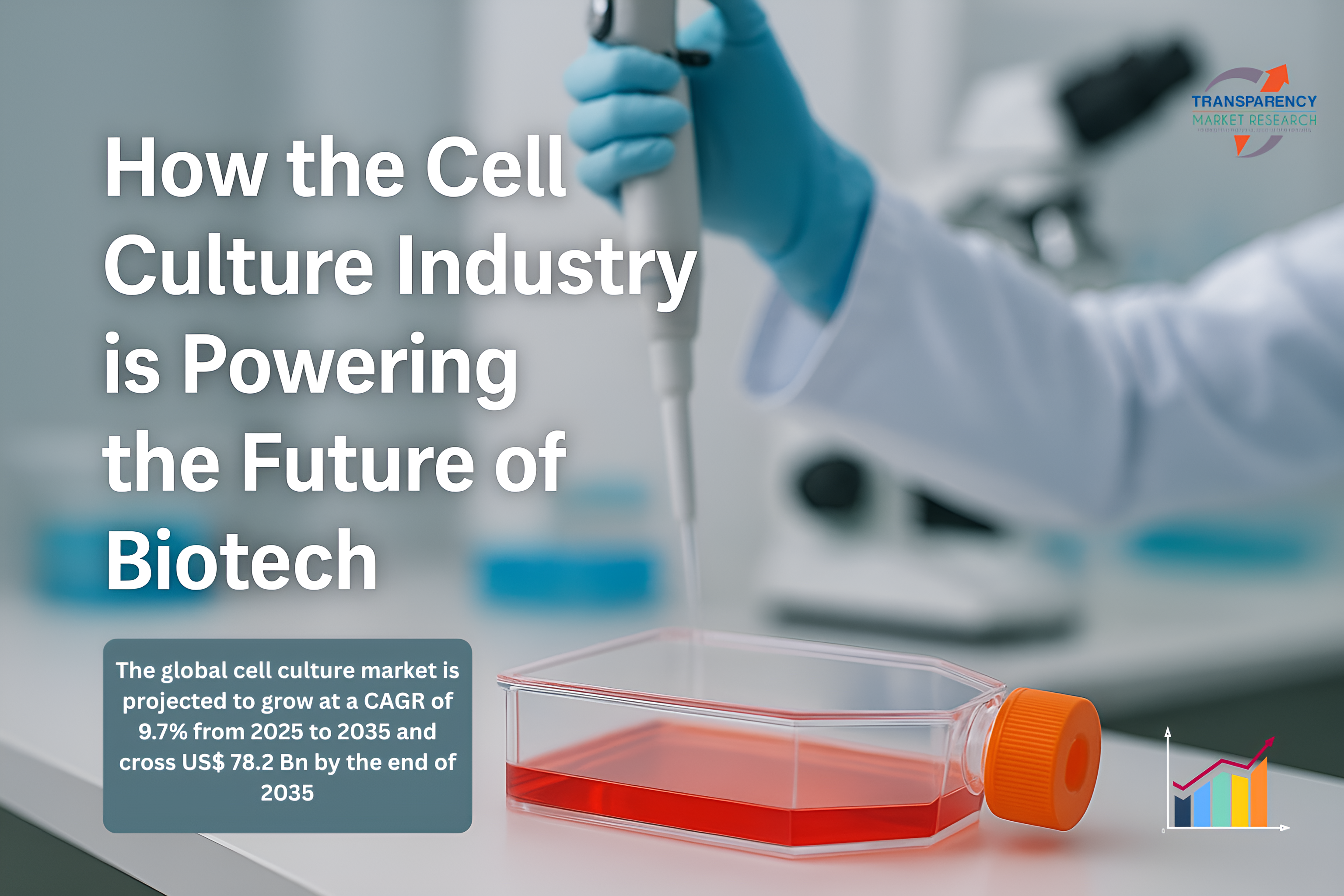
And the statistics support this growing importance. The cell culture market of the world was valued at US$ 28.2 billion in 2024. And today it is expected to increase exponentially. According to recent projections, the cell culture market is expected to grow at a CAGR of 9.7% from 2025-2035 and is expected to touch the projected value of US$ 78.2 billion by 2035.
But why are they expanding? And what does the future hold for this fast-growing industry?
Let us go deeper into the revolutionary role of cell culture and how it’s transforming the future of science, medicine, and beyond.
What is Cell Culture?
Basically, cell culture is the growth of cells—animal, plant, or microbial—in controlled environments away from the natural environment. The cells are grown in laboratories with specially formulated media that supply the nutrients, hormones, and growth factors required for their proliferation and growth.
Whether immortalized cell lines used in drug testing or primary cultures being harvested directly from living tissues for personalized therapies, cell culture is the unifying pillar of biomedical research today.
It’s the entrance to:
- Understanding diseases at the cellular level
- Producing biologics like monoclonal antibodies
- Vaccine manufacturing (e.g., COVID-19 vaccines)
- Pioneering stem cell and regenerative medicine therapies
- Growing meat without growing animals (lab-grown meat)
- Ethical testing of cosmetics and skincare
In brief, the cell culture industry is not just growing cultures—it’s growing possibilities.
What is Driving Market Growth?
The strong projected growth of the cell culture industry—from US$ 28.2 Bn in 2024 to US$ 78.2 Bn in 2035—is no accident. It is supported by a sequence of strong trends that are transforming science and healthcare worldwide.
1. Growing Demand for Biologics
Biologic drugs—treatments that are derived from living organisms—are increasingly in demand for the management of long-term diseases like cancer, rheumatoid arthritis, and multiple sclerosis. Biologic drugs rely significantly on systems of cell culture for their production and large-scale production.
2. Boom in Vaccine Production
The pandemic highlighted the production of vaccines. From viral vector vaccines to mRNA platforms, cell culture has been the focus. Even as COVID-19 stabilizes as an endemic, the infrastructure and attention it afforded has sped the development of cell culture in immunology and virology.
3.Stem Cell and Regenerative Medicine Breakthroughs
Stem cells are poised to cure neurodegenerative disorders, diabetes, and even organ regeneration. Stem cell culture necessitates highly advanced and expandable cell culture platforms—a field that has witnessed explosive investment and innovation.
4. Emergence of Precision Medicine
Personalizing treatments to the unique cellular or genetic profile of an individual patient is the future of medicine. That future is based on patient cell cultures to attempt to tailor treatments before they are given.
5. Ethical Testing of Cosmetics and Chemicals
As testing on animals is more and more limited, businesses have turned to in vitro (laboratory) testing with human cells. It’s moral, precise, and getting cheaper and cheaper.
Industrial and Research Applications: Where Cell Culture Shines
Cell culture is at the center of a number of major industries. Why?
Pharmaceuticals & Biotech
From research and development to industrial production, pharma and biotech companies rely on cell culture for:
- Drug testing and toxicity assays
- Monoclonal antibody production
- Cell and gene therapy development
Academic & Research Institutions
Universities and governmental research institutes are the backbone of basic science. Their increased interest in cancer biology, neuroscience, and tissue engineering generate a huge demand for high-level culture systems and reagents.
Clinical Diagnostics
Cell-based diagnostic reagents that reach the market allow better prediction of disease and response to treatment. Infectious diseases are also identified by culture-based assays in microbiology laboratories.
Food Technology (Cultured Meat)
Lab meat is no longer a fantasy. Companies are using stem cell culture techniques worldwide to grow meat that is very tasty, reducing the level of environmental impact in food production.
Market Drivers through Innovations
As the cell culture industry matures, innovation is accelerating in all and every aspect—media, equipment, and methods.
1. Chemically Defined and Serum-Free Media
Fetal bovine serum (FBS) has been the industry’s gold standard for decades, but ethical concerns and issues related to variability are pushing the market towards animal-free and serum-free media. These next-generation types of media offer enhanced reproducibility and are ethical-compliant.
2. Automation and High-Throughput Systems
Robotic manipulation and automated culture technology are enabling laboratories to handle thousands of samples simultaneously. This makes efficiency achievable and drives therapies into the market earlier.
3. AI and Data Analytics Integration
Intelligent systems are now modeling cell growth patterns, making predictions, and even proposing optimization stages. This AI-based system is especially useful in scaling up personalized therapy on a large scale.
4. 3D Cell Cultures and Organoids
2D cultures are being more and more supplemented with 3D structures similar to real tissues. These systems offer better models for cancer research, drug screening, and regenerative medicine.
Regional Landscape: Who’s on the Frontlines?
North America
With top biotech companies and research organizations, the U.S. is the most extensive market, backed by significant investments in pharmaceutical R&D and academic R&D.
Europe
The EU is also investing heavily in cell and gene therapy research, particularly in regenerative medicine. The regulatory landscape also becomes increasingly favorable to cell-based technologies.
Asia Pacific
China, Japan, and South Korea are becoming the key drivers, based on rising healthcare infrastructure, government support, and growing demand for biologics as well as vaccines.
⚖️ Challenges to Overcome
Although it has a powerful growth curve, the cell culture industry has some challenges:
- Very high media and reagent expense, especially for specific applications
- Batch-to-batch variation, particularly in serum-containing systems
- Scalability issues in scaling up from research to industrial manufacture
- Ethical concerns over sourcing of certain biological components
But these issues are already being met head-on, with advances in microfluidics, bioreactors, and closed-loop systems promising more robust, scalable solutions.
Looking Ahead: The Future Is Living
The cell culture industry is not just a biotech sector—it’s the biological foundation for medicine, food, and science tomorrow. As we head towards a world of therapies directed at specific targets, lab-grown tissue, and cruelty-free testing, cell culture will be the engine.
With market size projected to be worth US$ 78.2 billion by 2035, there is no denying that the cell culture revolution is here and it’s larger than life.
Do you employ cell culture technologies?
No matter whether you are in pharma, academia, or food tech, comment below and share your experience or opinion. Let’s connect and talk about how cells are going to shape the future of health and humanity.