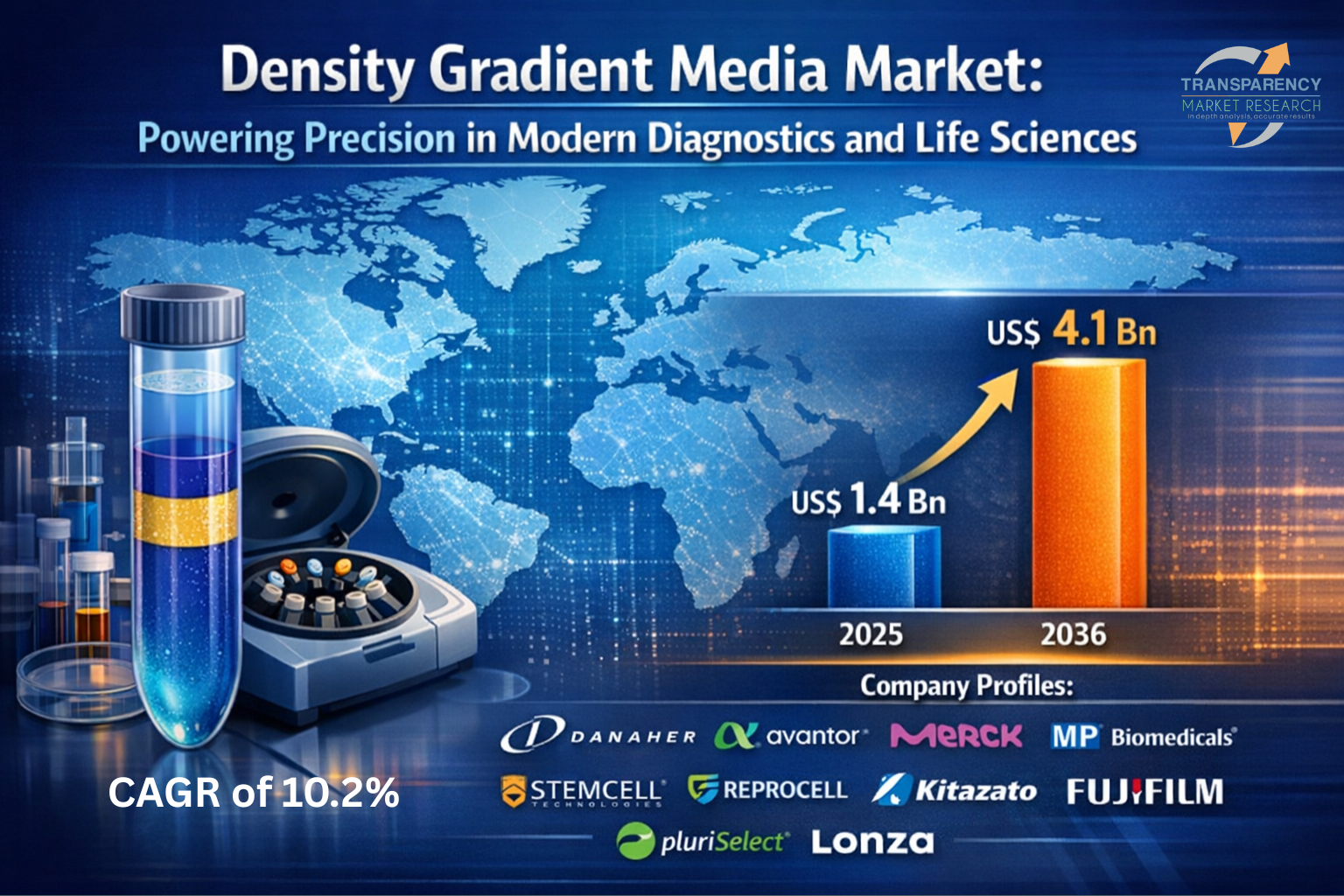
The global healthcare and life sciences landscape is evolving rapidly, driven by the need for faster diagnostics, advanced cell-based research, and precision medicine. At the heart of many laboratory breakthroughs lies an unsung hero—density gradient media. According to recent industry insights, the global density gradient media market was valued at US$ 1.4 Billion in 2025 and is projected to reach US$ 4.1 Billion by 2036, expanding at a robust CAGR of 10.2% from 2025 to 2036.
This remarkable growth reflects the rising demand for rapid infectious disease screening, improved cell separation techniques, and technological advancements that enhance sensitivity and multiplexing capabilities across diagnostic platforms.
Why Density Gradient Media Matters More Than Ever
Density gradient media are essential reagents used to separate cells, organelles, viruses, and other biological particles based on their density. From clinical diagnostics to research laboratories and biopharmaceutical manufacturing, these media enable precise and reliable separation processes.
The increasing prevalence of infectious diseases, growing focus on early diagnosis, and the expansion of cell and gene therapy pipelines are accelerating demand. Laboratories today require solutions that deliver high reproducibility, reduced contamination risk, and compatibility with automated workflows. As healthcare systems prioritize faster turnaround times and improved accuracy, density gradient technologies are becoming indispensable.
Moreover, advancements in multiplex testing—where multiple biomarkers are analyzed simultaneously—are further boosting the adoption of sophisticated gradient media solutions that maintain cell integrity while delivering consistent results.
Growth Drivers Shaping the Market
1. Rising Demand for Rapid Infectious Disease Screening
Global health emergencies have underscored the importance of quick and accurate diagnostic tools. Density gradient media support the efficient isolation of specific cell types or pathogens, enabling laboratories to accelerate disease detection and response strategies.
2. Technological Advancements in Separation Techniques
Modern density gradient formulations are designed for enhanced sensitivity, improved reproducibility, and compatibility with automated systems. Innovations in media composition and production technologies are significantly improving separation efficiency.
3. Expansion of Cell and Gene Therapy Research
The growth of regenerative medicine and advanced therapies requires precise cell isolation processes. Density gradient media play a crucial role in stem cell research, immunology studies, and cell-based therapeutic development.
4. Growing Biopharmaceutical Production
Biopharmaceutical companies rely heavily on high-quality separation tools to maintain product purity and compliance. As global biologics production expands, so does the demand for reliable gradient media.
Competitive Landscape: Leading Companies Driving Innovation
The density gradient media market features strong participation from global life science leaders and specialized biotechnology firms. Prominent players include:
- Danaher Corporation
- Avantor, Inc.
- Merck KGaA
- MP Biomedicals LLC
- STEMCELL Technologies Inc.
- REPROCELL Inc.
- Kitazato Corporation
- FUJIFILM Holdings Corporation
- pluriSelect Life Science
- Lonza
These companies are investing heavily in R&D, strategic partnerships, and geographic expansion to strengthen their market positions. Their focus remains on enhancing product performance, scaling production capacity, and ensuring regulatory compliance across global markets.
Noteworthy Industry Developments
Recent developments highlight the dynamic nature of the density gradient media landscape.
- In August 2025, EDM Resources Inc. announced the final results of a Dense Media Separation Study conducted on zinc and lead composite samples from its Scotia Mine. While primarily linked to mining applications, such studies emphasize the broader industrial utility of density-based separation technologies.
- In June 2025, Cytiva, a subsidiary of Danaher Corporation, completed approximately US$ 1.6 Bn in strategic investments across the U.S., Europe, and Asia-Pacific. These investments are aimed at expanding production capacity for media and other consumables while strengthening the global supply chain. This move reflects the growing demand for advanced separation solutions and the need for resilient manufacturing networks.
Regional Outlook
North America continues to dominate the market due to strong biotechnology research infrastructure, rising healthcare expenditure, and the presence of major industry players. Europe follows closely, supported by robust academic research programs and biopharmaceutical innovation.
Meanwhile, the Asia-Pacific region is expected to witness the fastest growth during the forecast period. Expanding healthcare infrastructure, increased government funding for life sciences research, and growing pharmaceutical manufacturing activities are key contributing factors.
Future Outlook: Toward Precision and Automation
Looking ahead to 2036, the density gradient media market is poised for transformative growth. Automation in laboratory workflows, integration with digital diagnostic platforms, and increasing adoption of personalized medicine will redefine separation technologies.
Companies that focus on high-purity formulations, scalable production, and sustainable manufacturing practices will likely gain a competitive edge. Furthermore, collaborations between biotech firms and academic institutions will continue to accelerate innovation.
With its critical role in diagnostics, research, and therapeutic development, density gradient media is no longer just a laboratory consumable—it is a cornerstone of modern life sciences. As healthcare systems worldwide demand greater precision and speed, the market is set to expand significantly, unlocking new possibilities in disease detection, treatment development, and scientific discovery.