Invisible ceramics are the actual transparent ceramics made from Silicon oxynitride and Sialon minerals. It’s these regions that transparent ceramics have emerged into one of the most promising advanced materials of the future. They combine the strength and durability of traditional ceramics. Together with the glass’s exquisite optical qualities, a one of a kind combination of properties bridges numerous new opportunities cross sectors such as defence, electronics, optics and medicine.
From configurable windows in military systems to infrared domes in missiles, next gen laser systems and transparent biomedical implants, transparent ceramics are now crucial in high performance and high stakes fields.
Market Overview: From Niche to Global Opportunity
The transparent ceramics industry was valued at US$ 1,020.0 million in 2024, underscoring its rapid evolution from a niche material class to a mainstream industrial resource. Just a decade ago, transparent ceramics were primarily confined to research labs or Défense-related use.
Valued at USD$ 1,020.00 million from 2024, this sector underscores how extremely fast the region is evolving from off a niche material class into the mainstream industrial resource of the transparent ceramics market. Only a decade ago, it was primarily confined to research labs or defense related uses settings. Transparent ceramics are gaining widespread adoption driving tremendous growth across commercial sectors.
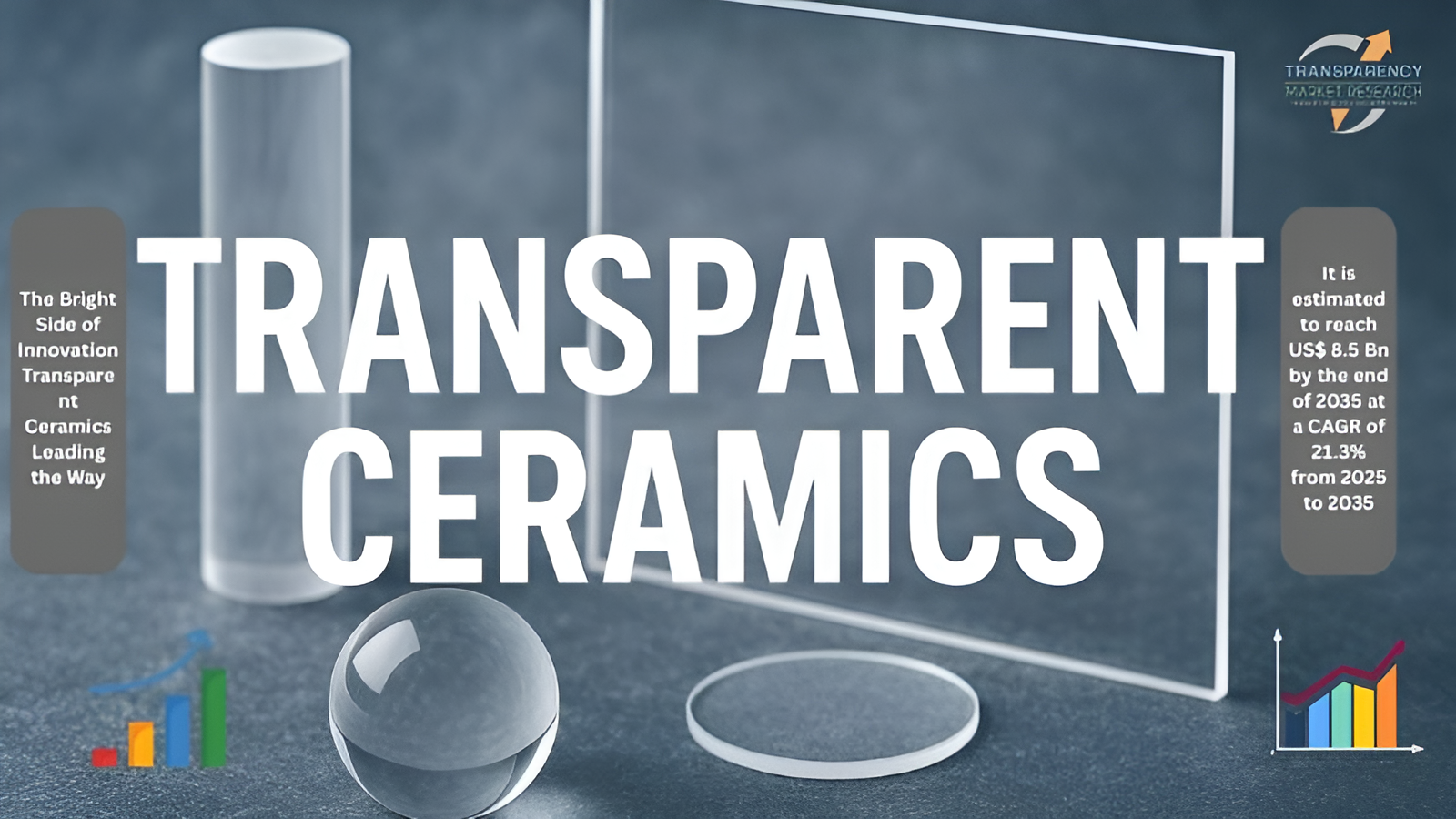
Following this scoped market is expected to grow at a breath taking CAGR of 21.3% from 2025 to 2035, one of the fastest rates in the advanced materials segment. At the end of this period, the market is expected to attain an estimated value of US$ 8.5 billion due to innovation, growth in production scalability, and increased demand from various high-tech industries.
What are Transparent Ceramics?
In contrast to standard ceramics which are generally opaque and tend to shatter easily, transparent ceramics are a class of materials that are designed to transmit light whether visible, infra-red, or ultraviolet. This can be done through processing aluminium oxynitride (ALON), spinel (MgAl₂O₄), yttrium aluminium garnet (YAG) and others through advanced sintering and hot isostatic pressing methods.
These materials are not only optically transparent – they are also incredibly tough, scratch resistant, thermally stable, chemically inert, and possess superior optical and mechanical properties compared to glass and a number of polymers.
Factors Contributing Towards Surge in Market Growth
There are powerful factors that are coming together to increase the market for transparent ceramics:
- Defense and Security Applications
The defense industry has been one of the first users of transparent ceramics. ALON and spinel materials are incorporated into bulletproof window, IR sensor domes, windows for armored vehicles, and laser rangefinders. Unlike traditional glass or plastics, these ceramics are more brittle and better transmit light which is essential for combat ready equipment.
- Optical and Laser Technologies
Higher power lasers rely on components such as YAG, a transparent ceramic, due to its endurance against high temperatures and extreme optical precision. This makes YAG suitable for medical lasers, industrial cutters, and communication tools.
- Consumer Electronics
As new smartphones, wearable devices, and cameras are being released with heightened expectations, manufacturers have changed their approach by using transparent ceramics in place of glass. Transparent ceramics are more thermally and scratch resistant, making them ideal for next-gen device lens and display covers.
- Medical Applications
In the health care system, these ceramics are used in biotic production, dental and surgical units where both transparency and bi-physicality are needed. Their passive nature and power ensure long -lasting performance in a sensitive environment.
- Energy and Aerospace
Due to resistance against UV radiation and thermal cycling, transparent ceramics are being researched for use in aircraft at high temperature sensor windows, as well as solar concentrators and space optics.
Regional Insights: Where Growth Happens
The transparent ceramics market spans the globe, but specific areas lead the way:
- North America stands as a key center propelled by defense budgets and cutting-edge manufacturing skills. U.S. military and aerospace sectors pioneer the use of transparent armor and high-precision optical ceramics.
- Asia-Pacific sees quick expansion in China, Japan, and South Korea. These nations pour money into electronics, laser tech, and car industries, all of which gain from transparent ceramics.
- Europe zeroes in on eco-friendliness and future healthcare, with firms investing in ceramic-based medical tools, energy-saving lights, and clean tech. Germany , houses several big materials science companies that push research and market entry.
Key Players and Innovation Scene
Top manufacturers and research centers are putting money into making production methods bigger cutting costs, and offering more material options. Some of the most busy companies in the see-through ceramics field include:
- Surmet Corporation – A trailblazer in ALON-based goods catering to defense and aerospace markets.
- CoorsTek Inc. – Known for their broad ceramic product range, including see-through materials for optics and medical use.
- Murata Manufacturing Co. Ltd. – Putting money into see-through ceramic parts for electronic gadgets.
- Saint-Gobain – A worldwide materials company looking into see-through ceramics for building and energy uses.
Market Challenges
While promising, the transparent ceramics market also has several challenges:
- High Manufacturing Costs
The technologies used in manufacturing defect-free, optically transparent ceramics are costly. Polishing, advanced sintering, and controlled atmospheres contribute to the expense, and therefore it is not affordable for low-margin applications.
- Scalability and Standardization
Consistent performance and quality in mass production remains difficult. Variations in transparency or strength may render them inappropriate for sensitive applications like in optics and aerospace.
- Substitute Materials
Advanced glasses and polymers still compete on cost and ease of manufacturing. Unless transparent ceramics can match these attributes economically, their adoption may remain confined to premium sectors.
The Future is Bright—and Transparent
As market value is expected to surge from US$ 1.02 billion in 2024 to US$ 8.5 billion by 2035, transparent ceramics are undoubtedly on the cusp of disruption-led growth. The staggering CAGR of 21.3% for the next decade is not only a testament to rising demand but also an indicator of the material’s established status as a strategic facilitator of future technologies. For more information please Request for Sample Brochure from here.
As additive manufacturing, AI-based design, and materials informatics continue to advance, we can anticipate even quicker creation of bespoke ceramic formulations for specialty uses. Additionally, as sustainability becomes increasingly relevant, transparent ceramics might be utilized in energy-efficient optics, ecosystem sensors, and solar technology to aid in cleaner, smarter infrastructure.
Conclusion: Crystal Clear Potential
Transparent ceramics represent a fascinating intersection of hardness, transparency, and flexibility. From protecting a fighter aircraft sensor dome to enabling a surgeon to be more precise with laser tools, the materials are transforming the potential for high-performance applications.
Their journey from the lab to widespread industrial implementation has been gradual but is now gaining momentum. With widespread uses in defense, healthcare, electronics, energy, and others, the market for transparent ceramics is poised to become a key driver in the material revolution of the 21st century.
As technology advances the boundaries of visibility and durability, transparent ceramics are a testament to what occurs when resilience and clarity combine—a truly revolutionary product with a crystal-clear future.
![Automotive Speaker Market [Speaker Type: Subwoofer, Midbass, Midrange, and Tweeter; and Application: Virtual Assistance, Entertainment, Warnings and Alerts, Guidance and Navigation, Automatic Pedestrian Alert System for BEVs, and Others (Fire Brigade, etc.)] - Global Industry Analysis, Size, Share, Growth, Trends, and Forecast 2024-2034](https://tmrblog.com/wp-content/uploads/2025/05/Wire-Cutting-Machine-3-Picsart-AiImageEnhancer.png)