Early and accurate detection has become the cornerstone of modern gastrointestinal (GI) care. As clinicians increasingly rely on advanced visualization techniques to identify subtle mucosal abnormalities, chromoendoscopy has emerged as a powerful tool. At the heart of this technique lie chromoendoscopy agents—specialized dyes and contrast agents that significantly improve lesion visibility during endoscopic procedures. With rising digestive health concerns worldwide, the chromoendoscopy agents market is gaining steady momentum.
Understanding Chromoendoscopy and Its Clinical Value
Chromoendoscopy is an endoscopic technique that involves the topical application of dyes to the mucosal surface of the gastrointestinal tract. These agents enhance contrast, highlight abnormal tissue patterns, and assist physicians in differentiating between benign and malignant lesions. Compared to conventional white-light endoscopy, chromoendoscopy offers improved diagnostic accuracy, particularly for conditions such as colorectal cancer, inflammatory bowel disease (IBD), Barrett’s esophagus, and early-stage gastric cancer.
As healthcare systems place growing emphasis on early diagnosis and preventive screening, chromoendoscopy is increasingly being integrated into routine GI evaluations—directly driving demand for high-quality chromoendoscopy agents.
Market Overview and Growth Outlook
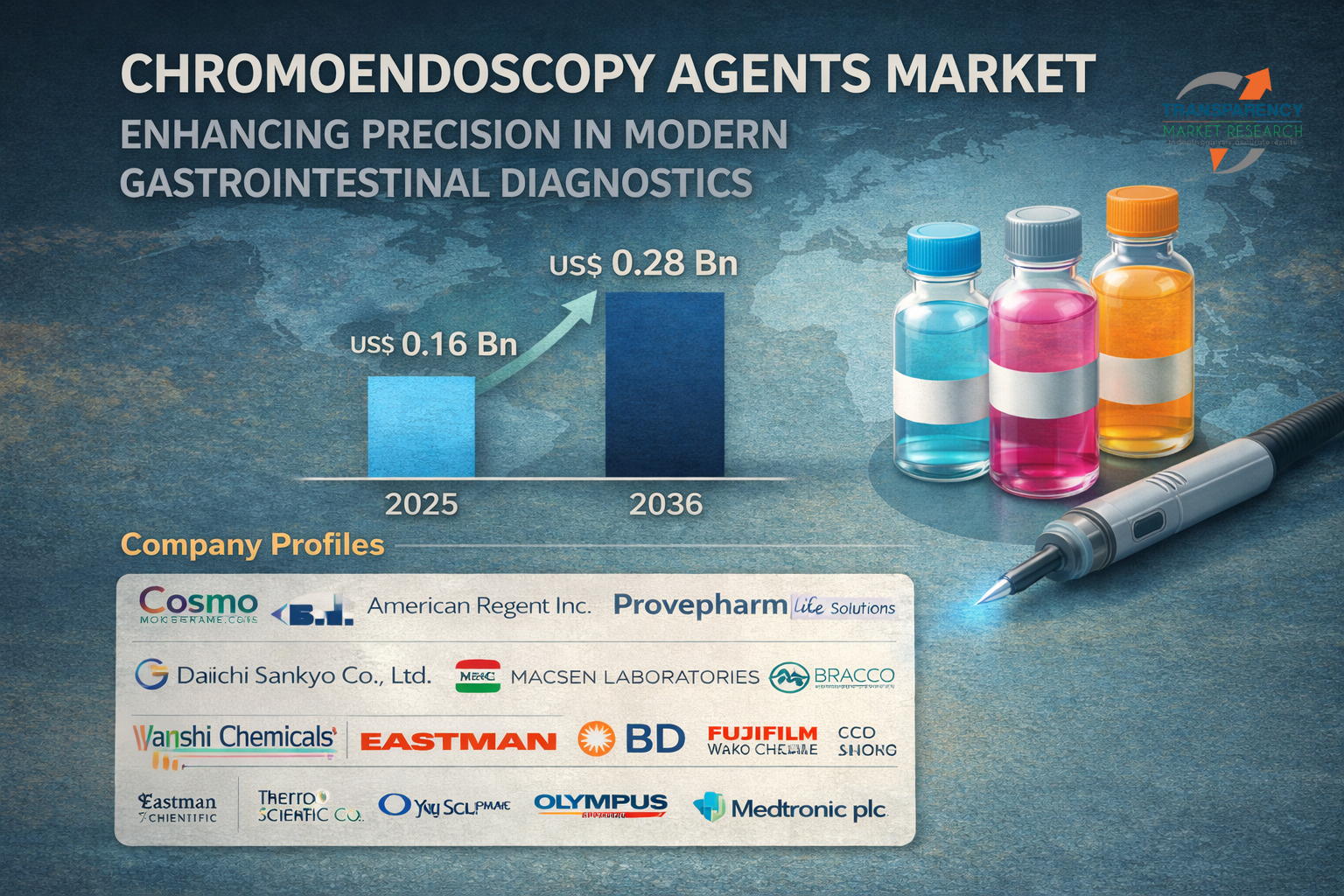
The global chromoendoscopy agents market was valued at US$ 0.16 billion in 2025 and is expected to reach US$ 0.28 billion by 2036, expanding at a compound annual growth rate (CAGR) of 5.2% from 2026 to 2036. This steady growth reflects the rising clinical adoption of enhanced endoscopic imaging techniques and the expanding patient pool requiring GI diagnostics.
Unlike short-term technology-driven surges, the chromoendoscopy agents market is growing on the back of long-term healthcare trends, including aging populations, lifestyle-related digestive disorders, and improved access to endoscopic procedures across both developed and emerging economies.
Key Drivers Fueling Market Expansion
Rising Incidence of Gastrointestinal Disorders
One of the primary growth drivers is the increasing global burden of gastrointestinal diseases. Conditions such as colorectal cancer, Crohn’s disease, ulcerative colitis, and gastric ulcers are becoming more prevalent due to dietary changes, stress, sedentary lifestyles, and aging demographics. Early detection of these disorders often requires enhanced visualization—making chromoendoscopy agents indispensable in clinical practice.
Growing Preference for Minimally Invasive Procedures
Minimally invasive diagnostics and treatments are now the gold standard in modern medicine. Patients and clinicians alike favor endoscopic procedures due to reduced discomfort, shorter recovery times, and lower complication risks. Chromoendoscopy fits seamlessly into this paradigm by enhancing diagnostic accuracy without adding procedural complexity.
Advancements in Endoscopic Technologies
The evolution of high-definition endoscopes, digital chromoendoscopy, and AI-assisted imaging has further boosted interest in chromoendoscopy agents. While virtual chromoendoscopy techniques exist, dye-based chromoendoscopy remains highly effective, cost-efficient, and widely accessible—especially in resource-limited healthcare settings.
Expanding Screening Programs
Government-led colorectal cancer screening initiatives and increased awareness of preventive healthcare are also contributing to market growth. As screening volumes rise, so does the use of adjunct tools like chromoendoscopy agents to improve lesion detection rates.
Competitive Landscape: Key Players Shaping the Market
The chromoendoscopy agents market is moderately fragmented, with a mix of pharmaceutical companies, specialty chemical manufacturers, and medical device leaders actively participating. Key players operating in the global market include Cosmo Pharmaceuticals N.V., American Regent Inc., Provepharm Life Solutions, Daiichi Sankyo Co., Ltd., Macsen Laboratories, Bracco Diagnostics Inc., Vanshi Chemicals, Eastman Chemical Company, BD, FUJIFILM Wako Pure Chemical, C2 Pharma, Thermo Fisher Scientific, TruBlue Beacon GI Marker (GI Supply), Otsuka Pharmaceutical Co., Merck KGaA, Boston Scientific Corp., Olympus Corp., and Medtronic plc.
These companies are focusing on product quality, regulatory compliance, and strategic collaborations to strengthen their market presence. Innovation in formulation stability, safety profiles, and ease of application continues to differentiate leading brands from generic alternatives.
Regional Insights and Emerging hooks
North America and Europe currently dominate the chromoendoscopy agents market due to well-established healthcare infrastructure, high adoption of advanced diagnostic technologies, and strong reimbursement frameworks. However, Asia Pacific is expected to witness the fastest growth during the forecast period. Rapid expansion of healthcare facilities, rising awareness about early cancer detection, and increasing endoscopy procedure volumes in countries such as China and India are creating lucrative growth opportunities.
Meanwhile, Latin America and the Middle East & Africa are gradually emerging as untapped markets, supported by improving diagnostic capabilities and growing investments in healthcare modernization.
Future Outlook: Where the Market Is Headed
Looking ahead, the chromoendoscopy agents market is poised for sustained growth rather than disruptive change. While AI-driven and digital imaging techniques will continue to evolve, dye-based chromoendoscopy is expected to retain its clinical relevance due to its proven efficacy, affordability, and simplicity.
Manufacturers that focus on regulatory approvals, global distribution networks, and clinician education are likely to gain a competitive edge. As early diagnosis becomes a universal healthcare priority, chromoendoscopy agents will play a vital role in improving patient outcomes across the GI care continuum.
Final Thoughts
The chromoendoscopy agents market represents a critical intersection of diagnostics, preventive healthcare, and minimally invasive medicine. With consistent growth projections, expanding clinical applications, and increasing global awareness of gastrointestinal health, the market is set to remain an essential component of modern endoscopic practice well into the next decade.