Time is of the essence in the race. Nowhere is this more evident than in the context of emergency medical response. Ambulance services are the first line of treatment during times of crisis — transportation, yes, but a mobile extension of hospital care. As populations age across the world, chronic diseases increase, city traffic intensifies, and healthcare infrastructure develops, the need for effective and high-tech ambulance services is experiencing a historic surge.
The ambulance industry is more than flashing lights and blaring horns; it’s technology, speed, coordination, and most importantly, saving lives. From air ambulances lifting off to remote rural communities to technology-driven ground ambulances providing life support in transit, the industry is changing rapidly — driven by innovation, public health needs, and shifting patient expectations.
Market Outlook: Steady Growth through 2035
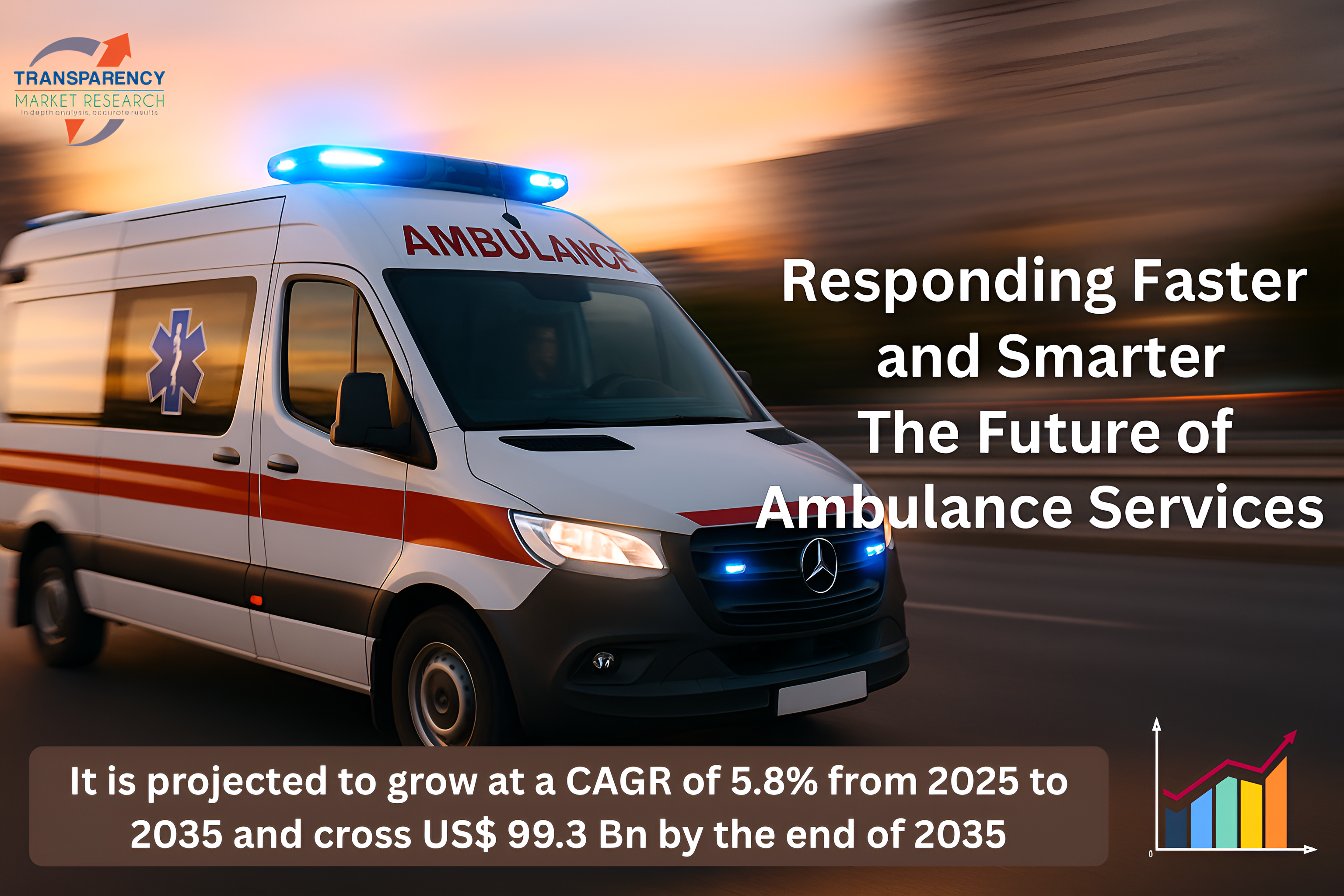
According to industry estimates, the market for global ambulance services stood at US$ 53.4 billion in 2024. It is anticipated to develop at a CAGR of 5.8% during the forecast period of 2025 to 2035 and reach over US$ 99.3 billion in 2035. The growth is backed by a combination of several factors like the growth in healthcare infrastructure in emerging markets, a rise in road accidents, growing government spend on emergency services, and the use of smart technologies on ambulances.
Of particular interest is that the market is growing beyond the traditional vehicle. Air ambulances (aircraft and helicopters), water ambulances, and even drones are being integrated into emergency response units in countries with logistical and geographical diversity of terrain.
Why did the demand spike?
Let’s break it down.
- Traffic Congestion and Urbanization:
As cities expand into megacities, the problem of transporting patients to the hospital on time is aggravated. Ambulances nowadays even have GPS, real-time traffic updates, and even priority beacons to reduce the travel time to the absolute minimum.
- Rise in Accident and Emergency Admissions:
Road traffic injuries are one of the major causes of mortality in the world, as reported by WHO. An ambulance facility that is timely and efficient can prove to be a matter of life and death. Similarly, cardiac arrest, stroke, or other condition-related emergencies require immediate pre-hospital intervention, which can be provided only by an equipped ambulance.
- Rising Geriatric Population:
As more people live longer, the demand for repeat medical transport, both emergency and non-emergency, has grown considerably. Ambulances now carry out not only emergency but also repeat hospital visits, dialysis, physiotherapy, and post-operative care transport.
- Technology Integration:
Ambulances today are not cars anymore — they’re mobile ICUs. AI-driven diagnostics, telemedicine on demand, and cloud-synced patient records make ambulances smarter, more efficient, and more effective at stabilizing patients during transport to the hospital.
A Peek into Service Types
The market segments are:
- Emergency Services: Emergency situations that require immediate treatment.
- Non-emergency Services: Scheduled patient transport for regular medical visits, hospital transfers, etc.
- Air Ambulances: Particularly useful for off-site or inaccessible locations.
- Private vs Public Services: While government-run ambulance services dominate developing nations, there are fast-growing private operators in cities offering luxury and on-call emergency services.
A look at service types
Marketing sections include:
- Emergency services: Livsdhamki conditions where immediate care is important.
- Non-founded services: Planned patient transport for regular medical appointments, transfer in hospitals, etc.
- Air ambulance: Especially important for remote or inaccessible areas.
- Private versus public services: While government-run ambulance services dominate development areas, private players quickly appear in city centers, Premium and On-Demand offer emergency room.
Market players: Who is driving in the future?
While ambulance services themselves are the end products, they trust more on a series of associated industries such as automotive industry, medical equipment, telecommunications and smart software. Companies such as Basf SE, Cowstra AG, Eastman Chemical Company, Lanxess and Sabic indirectly contribute through their innovations within lasting cars of motor vehicles and medical quality, used in the production of light, durable and safe ambulances inner and life supply systems.
For example:
- In November 2024, Cowstra AG announced a strategic partnership with Osel in China, which recycles the life vehicle’s plastic step with a circular economy target for motor vehicles and the ambulance car industry.
- TotalEnergies Corbion launched Luminy PLA bioplastics into the Chinese market in April 2024. The bioplastics are very versatile in medical-grade components in ambulances and gear as they are lightweight, biodegradable, and cost-effective. Their collaboration with Xiamen Changsu Industrial Co., Ltd. is to expand in the Asian market and offer eco-friendly solutions for future ambulances.
This convergence of automotive and med materials is vital. As ambulances become safer, lighter, and more environmentally friendly, materials science firms are doing the unexpected but vital work of creating the future of emergency medical services.
Challenges ahead
Despite the strong growth, the market for ambulance services is facing some obstacles:
- Lack of trained personnel: In many areas, the number of certified EMT (emergency medical technicians) and paramedics is insufficient.
- Cost barriers: Private ambulance services are often expensive and inaccessible to low -income population.
- Uneven distribution: In rural areas, especially in developing countries, emphasized by emergency services.
- Maintenance and upgrading: Continuous technological upgrades are expensive, and many service providers, especially public institutions, are struggling with old equipment and poor money.
What the Future Holds
We are headed towards a future where AI, predictive medicine, and smart city systems are going to transform the ambulance service. Imagine this: a heart attack is detected by a wearable device, its signal is sent to the nearest ambulance, traffic lights are diverted on its route, and doctors begin monitoring remotely even before the ambulance arrives at the destination.
This isn’t science fiction — this is where the industry is headed.
Aside from that, green ambulances with electric or hybrid motors are also gaining popularity. As the world continues to make more sustainability commitments, green medical transport will also be the norm for urban cities in the coming ten years.
Final Thoughts
The ambulance services industry is not only expanding — it is evolving. What started as a basic response system now forms an integral part of the health system, bridging the gap between life and death. With technology on the upswing, greater health awareness, and public and private investments, the future looks bright, streamlined, and more humane than ever.
As patients continue to need smarter, faster, and more compassionate emergency care, now it’s time for manufacturers, physicians, and lawmakers to sound the sirens of progress — not warningly, but resolutely.