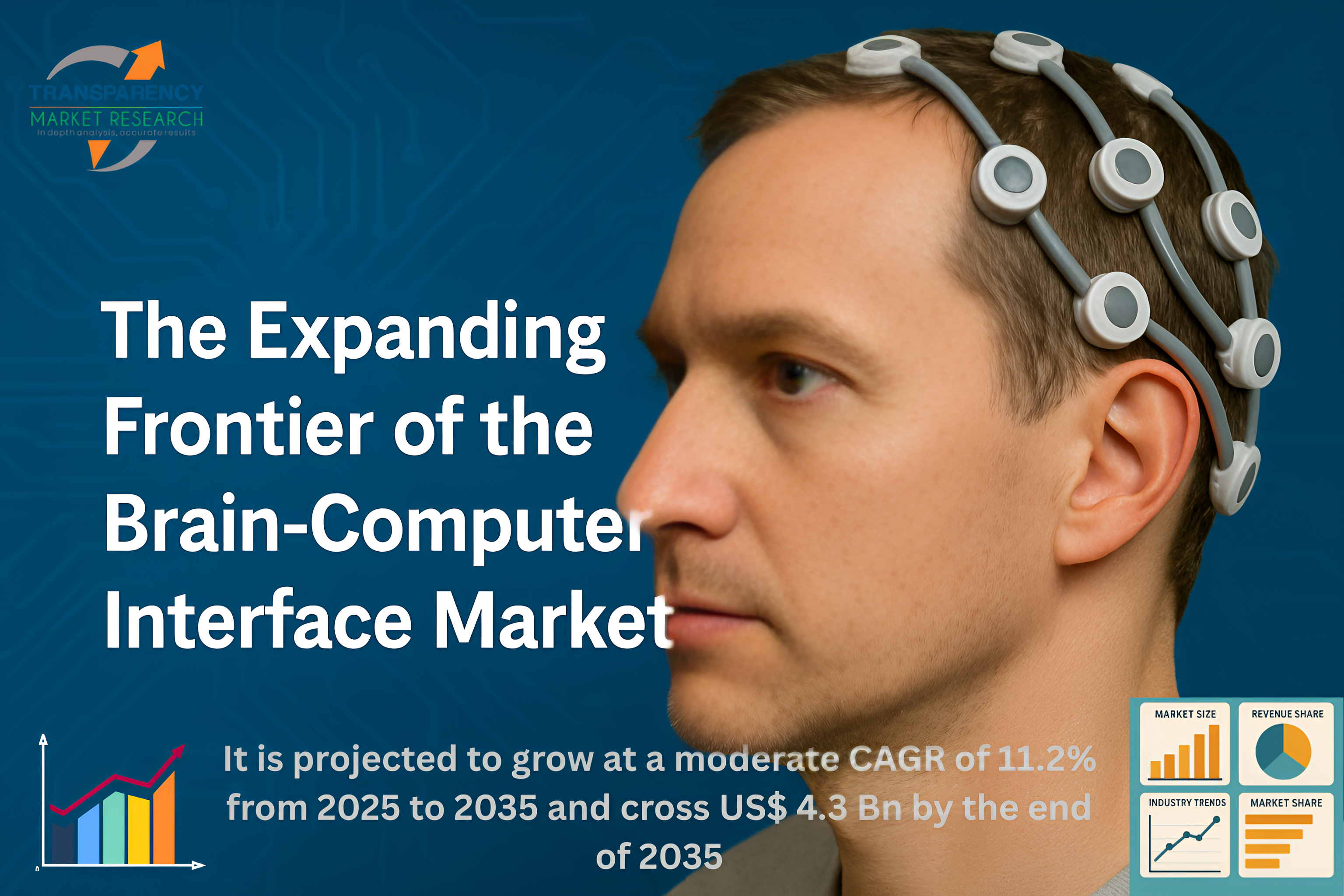
Imagine a world where a person with paralysis can move a robotic arm using only their thoughts—or a surgeon can map out cancerous brain tissue with microscopic precision in real time. Welcome to the fast-evolving world of Brain-Computer Interfaces (BCIs), where the human mind is no longer confined by the body, and technology becomes an extension of thought.
Though once the stuff of science fiction, BCI technology is today very much a reality—and a growing market. As of 2024, the global brain-computer interface (BCI) market stood at US$ 1.3 billion. Now, with innovation accelerating across terotechnology, artificial intelligence, and implantable devices, the market is projected to grow at a CAGR of 11.2% from 2025 to 2035, reaching US$ 4.3 billion by the end of 2035.
And why is this explosive shift happening, and who are the key players shaping the brain-machine interface of the future?
What is Brain-Computer Interface Technology?
A Brain-Computer Interface, or BCI, is an interface that allows a direct interaction between the outside world and the brain—a usually a computer, robotic arm, or software program. BCIs function by capturing electrical signals produced by brain activity and converting them into machine-readable commands.
Initially created for medical use—i.e., to assist individuals with neuromuscular disorders—BCI technology is branching out to other areas like gaming, virtual reality (VR), mental illness, and even consumer health.
Market Momentum: Why BCI demand increases
Many factors change to drive the demand for BCI technology globally:
- Medical advance
The most pronounced use for BCI continues in the medical field, where the lamb, epilepsy, Parkinson’s and other neurological patients are helped to achieve some resemblance to their lives control. From writing with eyes to running wheelchairs with brain signals, BCI opens new doors for autonomy.
- Aging population
As a population age worldwide, neurological disorders such as Alzheimer’s and disability after stroke. BCIS promises not only for rehabilitation, but also for real -time brain monitoring and medical administration.
- Technology development
Better algorithms, small sensors and wireless connection are more accurate, less aggressive and more intimate with other digital platforms.
- Venture capital and research funding
With the support of major investors and increasing collaboration between technology companies and schools, R&D in the region is at a record high. This investment regularly shortens the market for new technologies.
Large players who control the market
The BCI market is shaped by a mixture of historical medical equipment giants and new neurotechnic upstarts. Among the big players:
- Medtronic PLC
- abbott
- Boston Scientific Corporation
- Neurlink
- emotionally
- Blackrock Neurotech
- Paradromics
- Brainco Inc.
These companies have been outlined in detail in the global BCI market report on the basis of their financials, strategic emphasis, R&D spend, product portfolio, and recent partnerships or clinical studies.
Neuralink: Headlining (and Making) History
Among the most talked-about names in neurotech is Elon Musk’s Neuralink. In November 2024, Neuralink announced the PRIME Study, a clinical trial that will evaluate the safety and performance of its wireless, fully implantable BCI system. The company’s N1 Implant and R1 surgical robot are being tested for their ability to allow individuals who have quadriplegia to operate external devices such as smartphones and computers solely through their thoughts.
This test is a watershed moment for the company and the industry. With success, Neurlink technology can pave the way for commercially available human BCI transplantation that is minimal invasive, safe and very effective.
Inbraine Neurolectronics: Exactly in the operating room
In another milestone, in September 2024, Inbrain Neurohelectronics announced the first human application of their cortical interface during the removal of brain tumor removal.The interface allowed surgeons to discriminate between cancerous and non-cancerous tissue with micrometer-level accuracy—a huge leap in surgical neuro-navigation.
These accuracy-based BCIs can potentially transform brain surgery to make the operation safer and more efficient, particularly in complex tumor or epilepsy surgery.
This test is a watershed moment for the company and the industry. With success, Neurlink technology can pave the way for commercially available human BCI transplantation that is minimal invasive, safe and very effective.
Inbraine Neurolectronics: Exactly in the operating room
In another milestone, in September 2024, Inbrain Neurohelectronics announced the first human application of their cortical interface during the removal of brain tumor removal. In high-stress professions or education, this information can be applied to enhance health, productivity, and well-being indicators.
Further challenges: Morality, technical and regulatory
Promises that BCI technology is also rich in challenges:
– Attacation vs. accuracy
Aggressive implants give better quality signals, but risk surgery. Non-invasive people are safe, but potentially less reliable.
– Data Privacy
Nerve data is very intimate. Since BCIS is more often implemented, there is also concern about data security, consent and abuse.
– Regulatory Barriers
Before mass adoption, however, BCI devices must also pass through strict regulatory streams for safety, especially in medicine.
– Affordability & Accessibility
The steep costs will limit the use of BCI technologies. Long-term success will involve the devices being cost-effective and easy to use.
What the Future Holds
The future of the BCI industry is bright. With the technology being continuously perfected, we can look forward to:
- Increased miniaturization and wireless capabilities
- Deeper integration with machine learning and AI
- Increased use in diagnosis, therapy, and in daily life
- New partnerships between healthcare providers and tech firms
In 2035, with a market size of over US$ 4.3 billion, BCIs will be a part of everyday life for most—not just individuals with disability or neurological conditions but professionals, gamers, and consumers who wish to engage with technology in a smart manner.
Final Thoughts
The brain has been the last frontier of human beings—now we’re learning how to work with it directly. The field of brain-computer interface isn’t a field—it’s a movement toward a future where technology and thought are linked together.
From restoring movement and speech to the paralyzed to making brain-controlled devices a part of daily life, BCIs are changing the possible. With more funding, research, and visibility, this is one thing that is certain: mind-powered machines are not just on the horizon—they’re already here.