Diagnostic imaging is undergoing a revolutionary change as healthcare professionals rely on high-tech imaging devices for timely detection, accurate diagnosis and effective treatment planning. From CT scans and X-rays to MRI and PET scanners, imaging technology has become an integral part of modern medicine. They not only improve clinical outcomes, but also reduce the workload of invasive treatments, providing faster and more accurate pathways to care.
In recent years, the rise in chronic conditions such as cancer, cardiovascular diseases, and neurological disorders has boosted the need for sophisticated diagnostic imaging products. The world healthcare industry is also witnessing a quicker shift towards digital-based imaging systems that provide real-time data and remote diagnosis capabilities. The shift is also being fueled by the integration of artificial intelligence (AI) and machine learning algorithms that improve image interpretation speed and accuracy.
In addition to this, the creation of point-of-care and portable imaging devices is redefining diagnostic service delivery. The compact and portable platforms offer imaging capability at distant locations, emergency settings, and home care settings — expanding access to quality health. Diagnostic imaging not only enhances patient experience but also enables clinicians with enhanced insight for personalized treatment as technology continues to evolve.
Diagnostic Imaging Market Outlook 2035
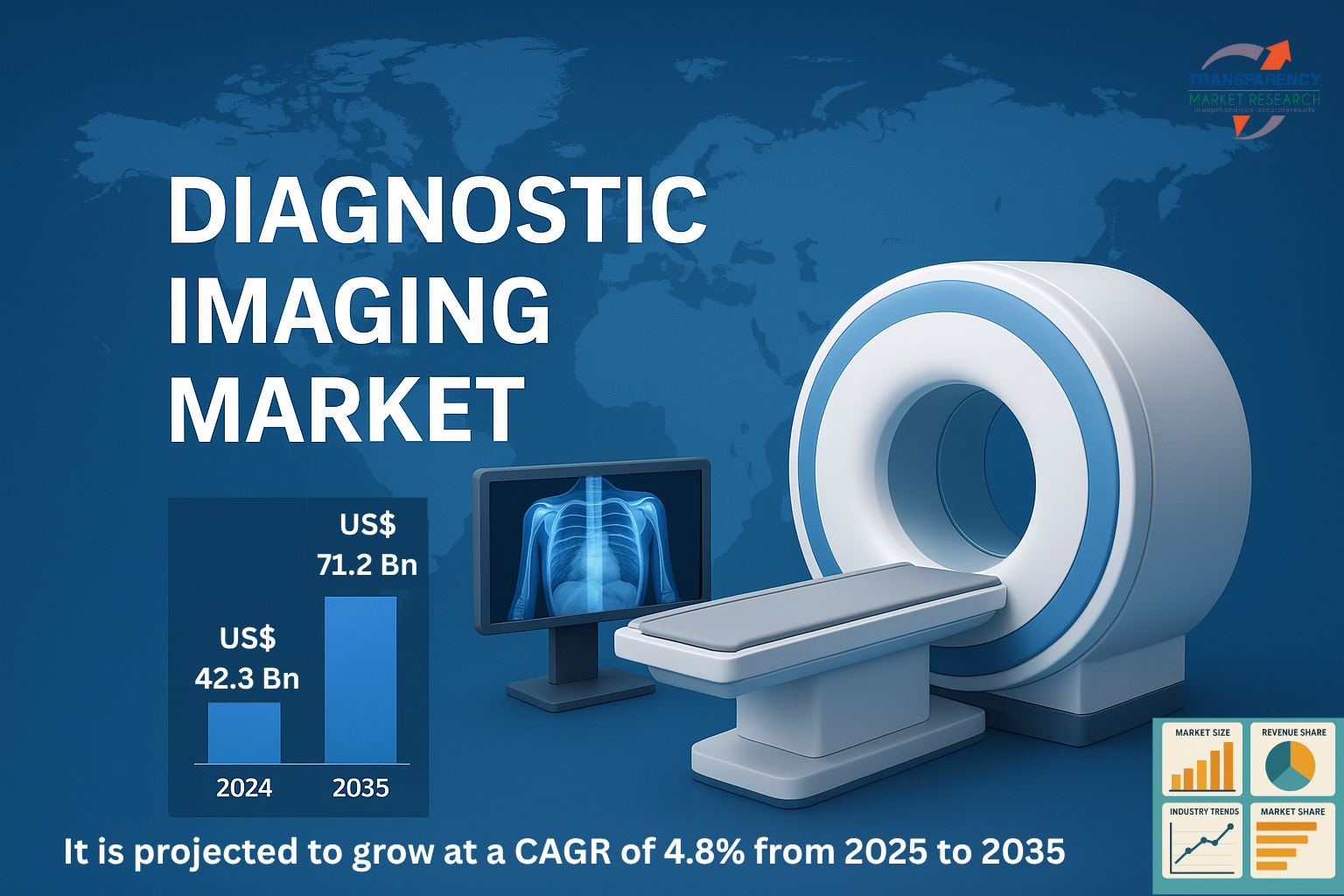
The global diagnostic imaging market was valued at US$ 42.3 Billion in 2024. It is anticipated to grow at a 4.8% rate between 2025 and 2035 and reach as high as US$ 71.2 Billion by the year 2035.
Analysis of Key Players in Diagnostic Imaging Market
Large players in the diagnostic imaging industry are committing to technological advancement, strategic partnerships, and innovation. They want to enhance imaging sensitivity and develop product portfolios so that they reach growth and dominance in the new healthcare environment.
Some of the major companies that hold a sway over this market include GE HealthCare, Siemens Healthineers, Koninklijke Philips N.V., Canon Medical Systems, Hitachi Healthcare, Hologic Inc., Bruker Corporation, Esaote SPA, Fujifilm Holdings Corporation, Shimadzu Corporation, Aurora Imaging Technologies, Inc., Shenzhen Mindray Bio-Medical Electronics Co., Ltd., Neusoft Medical Systems Co., Ltd., and Toshiba Medical Systems Corporation.
These firms have been profiled in the diagnostic imaging market study report with metrics such as company overview, financial overview, business strategies, product portfolio, business segments, and recent developments.
Technological advancements drive market expansion
Technological innovation is at the forefront of expansion in the imaging field. The use of AI-assisted imaging, 3D and 4D technologies and cloud-based data management systems are transforming traditional workflows into intelligent, networked diagnostic ecosystems. AI-powered tools are capable of scanning large amounts of data in seconds, allowing radiologists to detect blurred patterns invisible to the human eye.
Furthermore, the integration of hybrid imaging platforms, such as PET/CT and PET/MRI, gives clinicians a tool to acquire both anatomical and functional information within a single scan. These machines are particularly valuable in oncology and neurology, where precise imaging is required for therapy planning and for monitoring of the disease. The ongoing miniaturization of imaging devices as well as the advancement in mobile ultrasound systems also mark a step towards the democratization of diagnostic imaging — making it more affordable and more pervasive in different healthcare settings.
The growing role of AI and cloud-based imaging solutions
Artificial intelligence is now a big change in diagnostic imaging. The AI-powered algorithm can process hundreds of images in just a few seconds, helping radiologists identify abnormalities at an early stage and increase diagnostic confidence. For example, AI technologies used in mammography and breast imaging have significantly increased screening accuracy while reducing the number of false positives.
In addition, cloud-based imaging platforms are transforming the storage, sharing and analysis of medical data. Cloud computing makes it easier for healthcare professionals to work together across geographies, shortening the diagnostic cycle while maintaining data security and compliance with healthcare regulations. The digital revolution is supporting the growing demand for teleradiology and remote healthcare, especially in underserved communities.
Market trends and new opportunities
Some of the key trends driving the future of the diagnostic imaging market.
- High rates of chronic disease: The growing international burden of chronic disease continues to require early detection and imaging-based surveillance.
- Shift towards minimally invasive interventions: Imaging technologies are central to guiding and supporting less invasive interventions, improving patient outcomes and recovery times.
- Public spending and policy initiatives: Governments are investing in healthcare infrastructure and diagnostic centres, especially in emerging economies, which will increase penetration.
- Integration of 3D printing and augmented reality (AR): These tools are beginning to be integrated into image data for surgery planning, education and patient interactions.
Challenges and future prospects
Despite enormous growth potential, the imaging business also faces challenges such as equipment costs, a shortage of radiologists and strict regulatory requirements. However, continuous innovation through automation, AI-based image analysis and digitization significantly overcomes these challenges.
The diagnostic imaging field is likely to become even more patient-centred, data-driven, etc. in the future. New technologies such as wearable image sensors, predictive diagnostics with artificial intelligence and patient-specific imaging protocols will make disease detection and care a different story. By increasing diagnostic accuracy and efficiency, diagnostic imaging will continue to be a key component of global innovation and sustainability in healthcare.
Conclusion
The diagnostic imaging market is on the verge of healthy growth through 2035, fueled by the development of AI, cloud technology, and hybrid imaging platforms. As technology overcomes the traditional limitations, healthcare professionals are now better equipped than ever before to treat and diagnose diseases with precision. The coming together of industry leaders, researchers, and policymakers will be critical in shaping a future where diagnostic imaging not only saves lives but improves the quality and access to care globally.