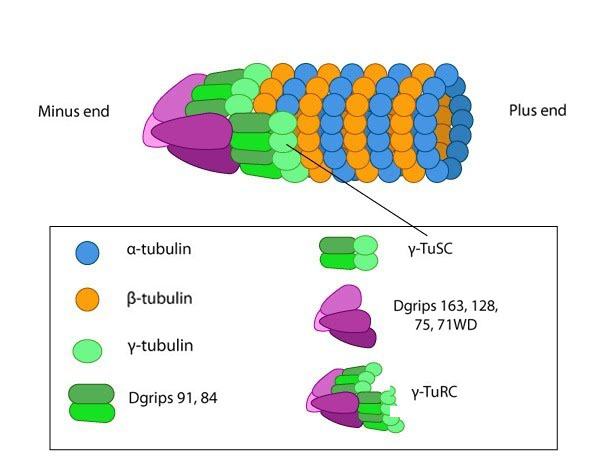
The cellular cytoskeleton, comprising microtubules, intermediate filaments, and actin filaments, plays a pivotal role in maintaining cell shape, facilitating intracellular transport, and mediating cell division. Among these structural components, microtubules stand out for their dynamic properties and diverse cellular functions. Microtubules are polymers composed of α- and β-tubulin heterodimers, with nucleation, elongation, and disassembly being tightly regulated processes crucial for cell physiology.
Among the key players in microtubule nucleation is the γ-tubulin ring complex (γTuRC). The γTuRC acts as a microtubule nucleator, initiating the assembly of new microtubules from αβ-tubulin dimers. Recent studies have shed light on the dynamic conformational changes of the human γTuRC during the microtubule nucleation process, particularly its transition into a closed conformation.
Understanding the mechanism behind this transition is vital for unraveling the intricacies of microtubule assembly and regulation, with implications for various cellular processes and potential therapeutic interventions.
The Structure and Function of the γ-Tubulin Ring Complex (γTuRC):
The γTuRC is a multi-subunit protein complex conserved across eukaryotes, comprising γ-tubulin and several associated proteins. It serves as the primary microtubule nucleator in cells, providing a template for microtubule polymerization and regulating microtubule dynamics.
The γTuRC consists of γ-tubulin molecules arranged in a ring-like structure, with additional accessory proteins stabilizing its architecture and facilitating its interaction with microtubule minus ends. The complex acts as a platform for the recruitment of αβ-tubulin dimers, promoting their assembly into nascent microtubules.
Microtubule Nucleation: An Overview
Microtubule nucleation is a tightly regulated process that occurs predominantly at microtubule organizing centers (MTOCs) within the cell, such as the centrosome in animal cells or the spindle pole body in yeast. The nucleation process involves the coordinated assembly of αβ-tubulin dimers into protofilaments, which subsequently form the cylindrical structure of the microtubule.
The γTuRC serves as the primary nucleator of microtubules, orchestrating the assembly of new microtubules from soluble tubulin subunits. Upon nucleation, the γTuRC catalyzes the formation of a stable microtubule seed, which serves as the foundation for further microtubule growth and organization within the cell.
Transition into a Closed Conformation
Recent structural and biochemical studies have provided insights into the conformational dynamics of the human γTuRC during microtubule nucleation. Of particular interest is the transition of the γTuRC from an open to a closed conformation, which is associated with its activation and recruitment of αβ-tubulin dimers.
In its inactive state, the γTuRC exists in an open conformation, with its γ-tubulin subunits arranged in an open spiral-like structure. This conformation limits its ability to efficiently interact with αβ-tubulin dimers and initiate microtubule nucleation. Upon activation, the γTuRC undergoes a conformational change, transitioning into a closed ring-like structure.
This closed conformation enables the γTuRC to tightly bind αβ-tubulin dimers and facilitate their assembly into microtubule seeds. The transition into a closed conformation is regulated by various factors, including post-translational modifications, protein-protein interactions, and the presence of microtubule-associated proteins.
Biological Implications and Future Perspectives:
The transition of the γTuRC into a closed conformation during microtubule nucleation has significant biological implications for cellular processes such as cell division, intracellular transport, and cell morphology. Dysregulation of microtubule nucleation can lead to aberrant cell division, genomic instability, and disease states such as cancer.
Understanding the molecular mechanisms governing the transition of the γTuRC conformation provides new avenues for therapeutic intervention and drug development. Targeting key regulatory factors involved in this process could offer novel strategies for modulating microtubule dynamics and disrupting cancer cell proliferation.
Elucidating the structural dynamics of the γTuRC may uncover new insights into the evolution of microtubule nucleation mechanisms across different species and cellular contexts. Comparative studies of γTuRC orthologs and homologs could reveal conserved regulatory mechanisms and structural motifs essential for microtubule organization and function.
Conclusion
The transition of the human γTuRC into a closed conformation represents a critical step in microtubule nucleation, regulating the assembly and organization of microtubule cytoskeleton within the cell. Advances in structural biology, biochemical assays, and imaging techniques have provided unprecedented insights into the molecular mechanisms underlying this dynamic process.
Continued research into the conformational dynamics of the γTuRC and its role in microtubule nucleation holds promise for addressing fundamental questions in cell biology and exploring new avenues for therapeutic intervention in diseases associated with microtubule dysfunction.